Section World
UK fields low-cost APKWS on Gulf Typhoons to blunt Shahed-style drone economics
Laser-guided 70mm rockets are reaching operational Typhoon loadsheets in weeks rather than years so interceptors can sit closer to the price of the one-way airframes they are meant to knock down—while ministers still have to balance magazine depth, basing access, and the rest of the regional air-defence stack.
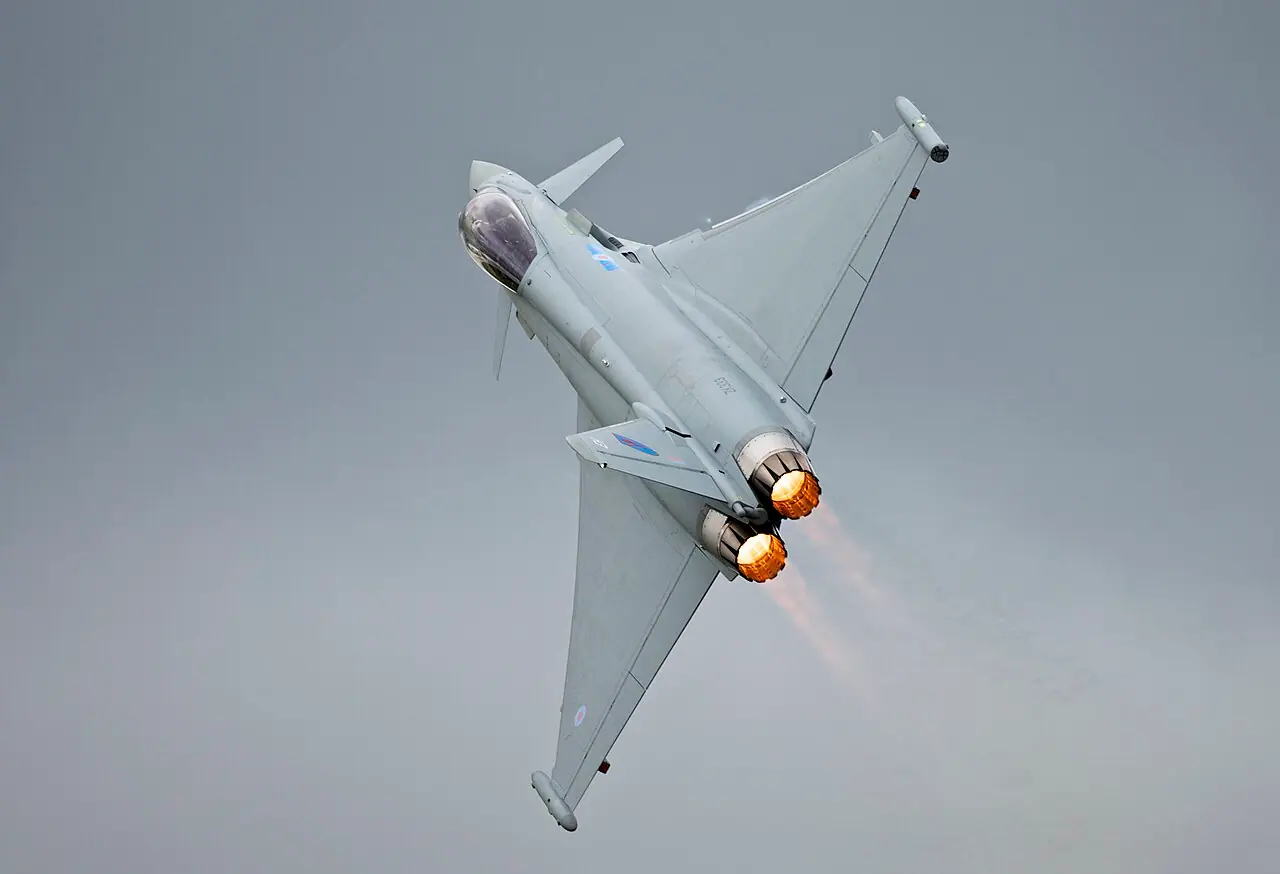
Royal Air Force Typhoon squadrons on Middle East task lines have gained a new answer to an old arithmetic problem: when an adversary can field long-range one-way attack drones for roughly the price of a family home in parts of Britain, firing missiles that each cost as much as a terrace house stops scaling.
Whitehall’s published line is that Typhoons will carry the Advanced Precision Kill Weapon System (APKWS)—essentially a guidance kit that turns standard 70mm Hydra-class rockets into laser-steered precision rounds—so crews can “destroy targets more precisely and at a fraction of the price” of the air-to-air weapons that previously dominated quick-reaction alerts. Industry trials with BAE Systems and QinetiQ were compressed into a matter of months, a pace that signals political urgency as much as engineering maturity.
The cost curve everyone can read from open sources
Open-source defence economics cited alongside the UK announcement often land near $20,000 per APKWS-class shot (other users are sometimes quoted closer to $30,000, or about £22,400 at recent rates), bracketing long-range Shahed-type airframes that independent estimates typically place around $20,000–$50,000 apiece. That contrasts with reporting from the 2024 Israel–Iran crisis cycle that put some British air-to-air interceptors used against drones at roughly £200,000 each. The MoD is not publishing a classified ledger, but the orders-of-magnitude gap explains why air forces across the Gulf are shopping for the same family of munitions: every successful intercept still consumes a weapon and a flying hour, so cheaper effectors preserve depth in the magazine.
That does not make APKWS a universal substitute. It is tailored to targets that can be designated and engaged within the rocket’s envelope; stealthier threats, dense swarms, or fights inside heavy electronic attack still pull crews back toward radar-guided missiles, ground-based radars, and layered command networks.
Where the jets are working and what sits alongside them
Official photography released alongside the announcement shows APKWS rails on Typhoons tied to RAF Akrotiri in Cyprus, a hub that absorbed a drone strike in March 2026 described by authorities as causing minimal damage and sits inside the wider eastern Mediterranean alert circuit. Regional reporting adds that British fast jets have logged more than 2,500 operational hours across the Middle East since the latest Iran crisis escalated, a scale figure that helps explain why ministers are sensitive to the unit cost of each defensive shot.
Defence officials have also pointed—without itemising every serial—to a broader British footprint that still includes ground and air-defence equipment hosted with Saudi Arabia, Bahrain, and Kuwait under long-standing cooperation arrangements. APKWS therefore lands as one line in a spreadsheet that still lists Sky Sabre-class radars and missiles, lightweight multirole missiles, and other rapid-deployment kits; the novelty is the economics of the fast-jet top cover, not the fact of British presence.
Political optics and the next vulnerability
Ministers emphasise solidarity with regional allies and “much lower cost” drone kills, language that doubles as reassurance to the Treasury and to Parliament that the RAF can sustain patrol tempo if low-cost threats persist. The risk they cannot price on a press release is substitution: if defenders cheapen the intercept, attackers can still push volume, flight paths under radar horizons, or fibre-optic-linked airframes less susceptible to radio jamming—each of which drags the problem onto different budgets and different science programmes.
For now, the story is narrowly about getting a proven American-origin guidance package onto British Typhoons quickly enough to change the marginal cost of a successful engagement. Whether that window stays open depends on production lines, export clearances for partners who want the same rounds, and the next move by whoever designs the drone that follows the Shahed.
Geography and themes
Related places and recurring themes for this story.
- United Kingdom
- Geopolitics
- Middle East
Suggested reading
Other stories that pair well with this one—often from the same section or on overlapping themes.
Brussels Brexit veterans say a UK return would mean normal EU membership, not the old carve-outs
Georg Riekeles and Sandro Gozi, among others, describe warmth toward a future application but zero appetite to recreate bespoke opt-outs; the Commission stays on this week’s brief—July summit prep—not hypothetical accession terms.
UK firms freeze capex and hiring plans as Hormuz-linked costs bite mid-market balance sheets
A BDO snapshot of five hundred mid-market companies finds three in five shelving or cancelling investment while Brent-style crude holds above one hundred dollars; parallel CIPD work shows fifty-eight per cent of employers putting cost control ahead of expansion with redundancy risks ticking up.
Israel boards Global Sumud flotilla off Crete; President Connolly’s sister sails on hull that slipped the net
Night-time interceptions in late April 2026 emptied more than twenty small craft of roughly 175–200 activists hundreds of nautical miles from Gaza, including seven Irish passport holders—while Dr Margaret Connolly, sister of President Catherine Connolly, remained with a companion vessel that organisers and reporters said had not been taken.
Cooper presses Gulf partners to reopen Hormuz routes farmers need for fertiliser
Britain’s foreign secretary has tied Iran’s disruption of the strait to fertiliser reaching African fields and wider prosperity, while parallel reporting documents urea spikes, stuck cargoes, and UN hunger modelling that treat the next planting cycles as the clock that matters.
Tehran floats Hormuz tolls on subsea internet cables as IRGC-tied media talk billions
Euronews and RFE/RL trace how Tasnim- and Fars-style outlets are packaging seabed leverage—transit fees, forced maintenance clauses, even cloud-giant localisation demands—while Mostafa Taheri, an Iranian parliamentary industries voice, throws around a headline revenue ceiling on the order of fifteen billion dollars annually that markets treated as rhetoric, not an invoice.
Belarus and Russia rehearse tactical nuclear delivery as Minsk dismisses alarm and Kyiv cries escalation
Missile troops and combat aircraft still drill covert moves and nuclear-use prep, but the same news cycle also airs Minsk’s insistence the exercise threatens no third country—set against Ukrainian Foreign Ministry warnings and Kremlin spokesman Dmitry Peskov’s pushback on Zelenskyy’s talk of a renewed Belarus-axis offensive.
India’s energy stress deepens as Hormuz risk drains crude tanks and forces pump-price catch-up
Commercial and strategic crude pools tracked by analytics houses have slid about fifteen per cent since late February while refiners keep runs high; Delhi is now bridging the gap with larger Atlantic and Russian-linked programmes, excise sacrifices, citizen conservation appeals, and the first visible retail increases after months of political patience.
IMF nudges up its 2026 UK growth call while flagging Hormuz and home-grown risks
Article IV staff now pencil about 1.0 per cent GDP growth for 2026 after a modest upward revision from April’s World Economic Outlook track, yet they still warn that a drawn-out Middle East conflict, volatile energy markets, and domestic hesitation could sap consumption and investment.
Manhunt in Norfolk after reports two teenage girls were raped on Great Yarmouth seafront
Norfolk Constabulary says it was called to South Beach Parade just after midnight on 16 May 2026; one man in his 30s is in custody after a Northamptonshire arrest while detectives hunt a second male suspect and ask witnesses to quote crime reference 36/34665/26.
NATO’s largest European special-forces rehearsal opens as Trojan Footprint 2026
Roughly three thousand American and allied commandos from twenty-three countries are training from the Baltic rim down through the Balkans and into the Mediterranean and Black Sea basins—led out of Stuttgart by U.S. Special Operations Command Europe with NATO’s special-operations headquarters in the same chain of command.
Keep exploring
Browse the full archive or return to the front page.
Sources and external links
Sources and filings our editors consulted to verify this story. External links open in a new tab.